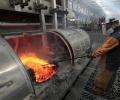
The Centre has conceded most of the demands of potential buyers of Neelachal Ispat Nigam Ltd (NINL). These include lowering the lock-in period for sale of assets to one year and allowing the new buyer to undertake the amalgamation of a special purpose vehicle (SPV) into NINL. An inter-ministerial group led by Department of Investment and Public Asset Management (Dipam) secretary Tuhin Kanta Pandey and the core group of secretaries on divestment (CGD) headed by Cabinet secretary Rajiv Gauba have decided that the lock-in period can be reduced to one year from the date of completion of sale, from the earlier three years proposed by Dipam, an official in the know said.

A bench headed by Chief Justice Ranjan Gogoi considered the submission of lawyer Prashant Bhushan, appearing for NGO Common Cause that there were wider issues of corruption affecting the probe agency and the PIL needed to be heard urgently.

Post-sale, the government stake would be 75 per cent, which will help NTPC to comply with the minimum public shareholding norms.

Older workers are headed for the VRS exit in larger-than-expected numbers even as unrest stirs over unrevised wage settlements.

Since the CJI was a part of the bench and author of the Tuesday's verdict which reinstated Verma as the CBI Director, he opted himself out of the panel's meeting which was ordered to be convened within a week.

After its unsuccessful bid to sell Air India in 2018, the government this time has decided to offload its entire stake.

The government will decide in August whether to sell a 5 percent stake in ONGC, a senior oil ministry official said, in a deal that would be worth $2.9 billion at current market prices.

States' spending doesn't improve the public image of the police, so where is the money going?

He further said Sidhu's resignation has been forwarded to Punjab Governor V P Singh Badnore.
Verma has sought quashing of three orders of October 23, 2018 -- one by the Central Vigilance Commission and two by the Department of Personnel and Training, as being without jurisdiction and in violation of Articles 14, 19 and 21 of the Constitution.

The Union Cabinet on Thursday approved a proposal to allow 100 per cent foreign direct investment (FDI) in public sector refiners, expanding the scope for FDI in the privatisation of Bharat Petroleum Corporation Ltd (BPCL). The approval by the Cabinet will enable the sale of the government's 52.98 per cent stake in BPCL to a foreign buyer, and, at the same time, will open the door for FDI in other public sector companies in the oil sector put up for privatisation.

"The strategic divestment transaction of Air India successfully concluded today with transfer of 100 per cent shares of Air India to M/s Talace Pvt Ltd along with management control," DIPAM secretary Tuhin Kanta Pandey said in a tweet. A new board, led by the strategic partner, takes charge of Air India, he added.

A lot of work is needed to be done on the part of the insurance sector behemoth, and the government, before it is ready for its market debut.

At present, bank depositors get an insurance cover of Rs 1 lakh on their amount by the Deposit Insurance and credit Guarantee Corporation.

It is in no way a government of the economic Right. The Right is limited to religion and nationalism. The rest is as Left as the Congress or any other party, observes Shekhar Gupta.

The 79-year-old widely respected and popular leader steered the Congress in 2017 to a landslide victory in the 117-member assembly to occupy the chief minister's post for the second time.

These officers also have been divested of their current duties on charges of violating Rules 9 and 3(1)(xx) of the Central Civil Service Conduct Rules.

Williams Grand Prix Holdings (WGPH) published results for 2019 showing Formula One revenue slid to 95.4 million pounds ($117.6 million) in 2019, down from 130.7 million pounds the previous year.

Against FY17 target of Rs 56,500 cr, Centre plans to fetch around Rs 6,400 cr in the first half.

To check fiscal deficit, government needs to drastically cut Plan expenditure.

On Saturday, Amarinder Singh had accepted Sidhu's "one-line" resignation and forwarded it to Punjab Governor V P Singh Badnore who conveyed his acceptance of the same.

Tata Sons has emerged as the top bidder for the takeover of debt-laden State-run airline Air India but the bid is yet to be approved by a group of ministers headed by Home Minister Amit Shah, sources said.

He has also sought stay of the Centre's order asking him to proceed on leave and giving the interim charge of his post to Joint Director M Nageswara Rao, a 1986 batch Odisha-cadre IPS officer.


This is not her first stint in North Block or in leading a major economic ministry. She started Prime Minister Narendra Modi's first term as minister of state for finance, was made the commerce minister, and then became the defence minister.

Merely bringing down the government stake below 51% may not find any taker for the PSBs. The government must bring down its holding to at least 26%, recommends Tamal Bandyopadhyay.

'The business continuity clause will mean the Tatas will have to keep running the airline for three years, and cannot exit the flying business.'

The Tatas have the know-how to quickly close deals which can otherwise get caught in legal wrangle. In 2018, on the day the National Company Law Tribunal declared Tata Steel as the winner of the bid for bankrupt Bhushan Steel, Bhushan promoter Neeraj Singhal was planning to file for a stay order. He did get the case listed for the following day, but the judge did not admit it, deferring it until the following week. The Tatas used the narrow window of 48 hours to close the deal and take control of the company.

Earlier this year, the Union Cabinet gave the management of state-run companies the freedom to decide on divesting their subsidiaries. However, the very next day a meeting was held at the top level of the Government of India, for the presentation of proposals for more autonomy for state-run companies. Interestingly, no chiefs of any of these companies were invited. It is a problem that will stare the government in the face with the state-owned banks too, as talks have again begun for inviting strategic investments in these companies.

'Had there been no war, maybe, we would come out with a 7.5 per cent stake sale.' 'At this point in time, a 3.5 per cent stake sale looked good.'
State-owned companies have been set stiff targets to increase accountability as they get ready for divestment. Nikunj Ohri explains why meeting them will be challenging.

While Road Transport Minister Nitin Gadkari has been dropped, the panel now has four ministers - Shah, Finance Minister Nirmala Sitharaman, Commerce and Railway Minister Piyush Goyal and Civil Aviation Minister Hardeep Singh Puri.
The govt may offload 9.5 per cent stake and bring its holding down to 75 per cent.

Centre might move swiftly on its next round of strategic sales in CPSEs

Sidhu, who had been at loggerheads with Chief Minister Amarinder Singh, had stayed away from all Congress activities ever since he resigned as cabinet minister last year.

Finance Minister Nirmala Sitharaman on Tuesday said monetisation of Central Public Sector Enterprises (CPSE) assets is based on the principle of value creation for the government and investors and would bring about a paradigm shift in infrastructure augmentation and maintenance. Chairing the National Workshop with the states/UTs on Asset Monetisation organised by Niti Aayog, the minister sought the collaboration of states for the holistic development of infrastructure. She said India can become a $5 trillion economy, while striking the right balance between fiscal imperatives and socio-economic welfare, through active collaboration between the public and private sector.

Soon after news of her being relieved from the water conservation portfolio became public, Munde said she was to reach Singapore to attend a global water leader summit on Monday but won't do so as she was no longer the minister of that department.

The changes are in view of the requests received from interested bidders and the prevailing situation arising out of COVID-19.

The AAP government appointed senior bureaucrat Arvind Ray as principal secretary.
